











category: SOS News
The Industry-Wide Shift to Fluorine-Free Foam
The firefighting industry is undergoing a fundamental transformation in response to PFAS (per- and polyfluoroalkyl substances) regulations. Federal and state mandates are systematically eliminating aqueous film-forming foam (AFFF) containing fluorinated surfactants due to environmental and health concerns. Fire chiefs and industrial facility managers must now transition to fluorine-free foam (F3) formulations: a change that requires comprehensive equipment evaluation and modification.
This transition extends beyond simply replacing foam concentrate. Fire apparatus designed for AFFF requires significant technical modifications to accommodate fluorine-free alternatives. Understanding these requirements is critical to maintaining operational readiness while achieving PFAS compliance.

Why Fluorine-Free Foam Functions Differently
Fluorine-free foams operate through fundamentally different suppression mechanisms compared to AFFF:
- No surfactant film formation: AFFF creates a thin aqueous film on the fuel surface that provides vapor suppression. Fluorine-free foams do not produce this film.
- Bubble-dependent suppression: F3 formulations rely entirely on foam blanket development and bubble stability to exclude oxygen and suppress fire.
- Hardware-dependent performance: Foam quality is directly influenced by proportioning systems, distribution networks, and discharge devices.
- Viscosity variations: Different F3 formulations exhibit varying viscosity characteristics that affect flow rates and system pressure requirements.
These operational differences necessitate equipment modifications across the entire fire suppression system. Apparatus designed for AFFF will not deliver optimal performance with fluorine-free foam without proper system upgrades.
System Component Replacement Requirements
Transitioning to fluorine-free foam typically requires replacing the entire fire suppression system, not merely the foam concentrate. Each F3 formulation is approved only for use with specific system components. Before implementing any changes, review manufacturer specifications for application requirements and compatible equipment.
Critical replacement considerations include:
- Proportioning systems: Foam proportioners must be calibrated for the viscosity and flow characteristics of the specific F3 formulation selected.
- Distribution piping: Existing piping may require modification to accommodate pressure requirements and foam expansion ratios.
- Storage tanks: Tank materials must be compatible with F3 chemistry to prevent degradation or contamination.
- Control valves and fittings: All wetted components require verification for chemical compatibility with the chosen formulation.
Switching between different fluorine-free foam products also necessitates component replacement. F3 formulations are not interchangeable: each requires system reconfiguration based on manufacturer approvals.

Discharge Device Modifications
Air-aspirating discharge devices are frequently required to optimize fluorine-free foam performance. Because F3 formulations depend on bubble development rather than film formation, discharge hardware directly impacts suppression effectiveness.
Discharge device requirements:
- Air-aspirating nozzles: These devices introduce air into the foam stream to create uniform bubble structure and optimal expansion ratios.
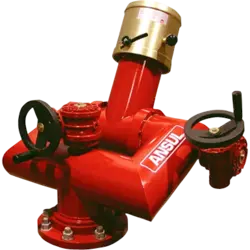
- Monitor nozzles: High-capacity applications require monitors designed specifically for F3 delivery, with proper aspiration capabilities.
- Fixed system discharge outlets: Storage tank protection and process area systems must be evaluated for compatibility with F3 expansion characteristics.
- Handline nozzles: Manual firefighting operations require nozzles engineered for fluorine-free foam application rates.
Standard non-aspirating discharge devices designed for AFFF will not produce acceptable foam quality with F3 formulations. This hardware upgrade represents a significant component of the transition process.
Fuel-Type Specific Considerations
Industrial facilities protecting polar solvents face additional complexity in the fluorine-free transition. Polar solvents are water-miscible fuels that destroy conventional foam blankets through dilution.
Alcohol-resistant synthetic fluorine-free foam (AR-SFFF) requirements:
- Polymer barrier formation: AR-SFFF formulations contain polymers that create a protective barrier between the foam blanket and polar solvent fuel.
- Specialized system components: AR-SFFF requires different proportioning equipment and discharge devices compared to standard F3.
- Application rate verification: Polar solvent protection demands higher application rates and specific foam delivery parameters.
- Fuel compatibility confirmation: Review FM Approval listings to verify which fuel hazards the chosen foam addresses and which system components are approved.
Facilities with mixed fuel hazards may require multiple foam systems or universal formulations with appropriate equipment configurations for each protected area.

Equipment Preparation and Testing Protocol
Before transitioning to fluorine-free foam, fire apparatus must undergo comprehensive preparation to remove PFAS contamination and verify system performance.
Mandatory preparation steps:
- Tank flushing with hot water: Thoroughly flush all foam concentrate tanks, including manual scrubbing of accessible interior surfaces.
- System circulation: Circulate hot water through proportioning systems, distribution piping, and discharge devices.
- Laboratory analysis: Submit rinse water samples to certified laboratories for PFAS analysis to confirm contamination removal.
- Component inspection: Examine all wetted parts for degradation, corrosion, or damage requiring replacement.
- Gasket and seal replacement: Install new seals and gaskets to prevent cross-contamination from residual AFFF.
Post-installation testing requirements:
- Foam quality testing: Conduct expansion ratio and drainage time testing with the new F3 concentrate to verify proper foam development.
- Proportioning accuracy: Measure concentrate percentage using conductivity testing or laboratory analysis.
- System commissioning: Perform full-scale discharge testing to validate application rates and coverage areas.
- Documentation: Maintain records of all testing, analysis results, and equipment modifications for regulatory compliance.
Inadequate system preparation compromises foam performance and may result in PFAS contamination of fluorine-free foam supplies.

SOS Safety International's Fluorine-Free Foam Expertise
SOS Safety International Inc. brings over two decades of experience in fire suppression systems and foam technology to the fluorine-free transition challenge. Our partnerships with industry-leading manufacturers including Ansul and 3M position us to deliver comprehensive solutions for PFAS compliance.
Our capabilities include:
- System assessment: Complete evaluation of existing fire apparatus to determine F3 compatibility and required modifications.
- Product selection: Recommendation of appropriate fluorine-free foam formulations based on protected hazards, equipment constraints, and operational requirements.
- Equipment specification: Identification of proportioning systems, discharge devices, and ancillary components required for optimal F3 performance.
- Installation support: Technical guidance for system modifications, component replacement, and commissioning procedures.
- Training: Operator training on fluorine-free foam characteristics, application techniques, and maintenance requirements.
- Compliance documentation: Assistance with regulatory reporting and documentation of PFAS elimination measures.
Our comprehensive product inventory includes approved fluorine-free foam concentrates, proportioning equipment, air-aspirating discharge devices, and complete fire suppression systems designed specifically for F3 applications.

Take Action on Your Fluorine-Free Transition
PFAS regulations are not future concerns: they are current mandates affecting fire departments and industrial facilities nationwide. Delaying the fluorine-free transition creates compliance risk and operational uncertainty.
SOS Safety International Inc. provides the technical expertise and equipment solutions required for successful PFAS compliance. Our team understands the complex requirements of fluorine-free foam systems and delivers tested, approved solutions ready for immediate implementation.
Contact SOS Safety International Inc. for a comprehensive consultation on your fluorine-free foam transition. Our specialists will evaluate your current apparatus, identify required modifications, and recommend solutions that maintain suppression effectiveness while achieving PFAS compliance.
For more information, visit SOS Safety International Inc. or contact our technical team directly. Quality service and reliable safety solutions are the foundation of our commitment to protecting lives and property.


