








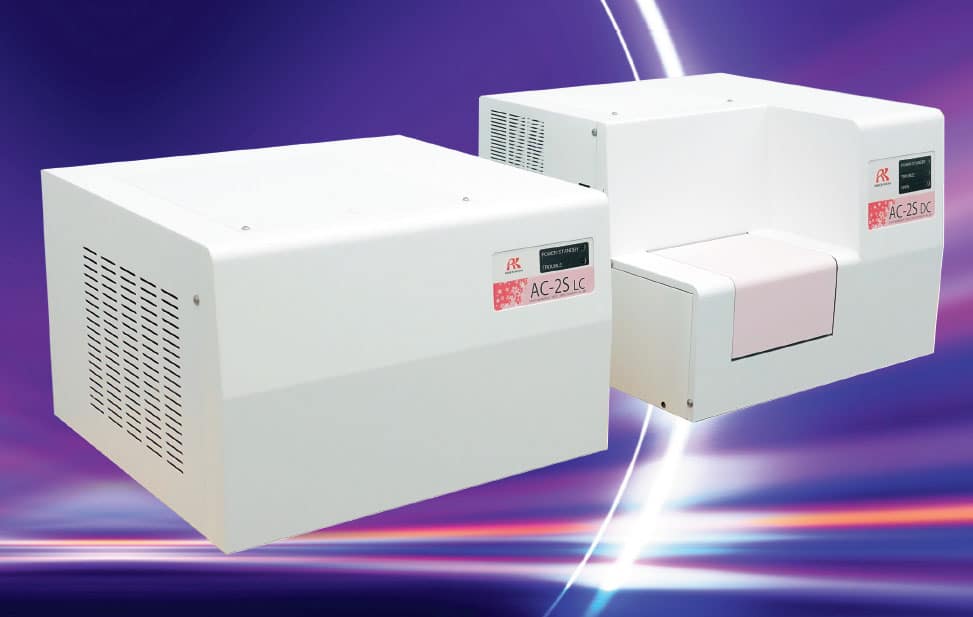
RKI AC-2S Photoemission Yield Spectroscopy in Air
AC-2S Spectrometer
- Allows easy measurement of work function and ionization potential in air
(Measurement time: approx. 5 mins*) - Measurements with high repeatability
Detects minute photoemission levels by subjecting samples to low intensity UV radiation. This minimizes damage to samples and assures high measurement repeatability.

The AC series is the “gentlest surface analyzer” that uses an ultra-sensitive electron sensor to count photoelectrons one by one in the air. The instrument irradiates the surface of a sample placed in the air with weak UV ray and extracts extremely small amounts of photoelectrons.
The measurement proceeds with minimal irritation to the sample surface. We can know the surface state of a material from the relationship between the UV energy and the number of photoelectrons. Now, let’s measure the true surface as it is in the atmosphere, without destroying the surface by X-rays or electron beam irradiation or by extracting a large number of electrons.
The AC Series is used widely in universities and research facilities around the world. Above 2,000 related articles have been published on scientific journals. Now we’ve added new features to meet the needs of researchers, for further ease-of-use refinements.
The AC-2S Series comprises three types
AC-2S for general analysis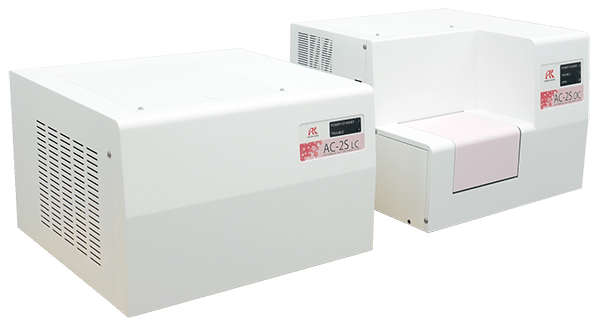
Basic model featuring reduced size and weight that retains the same all-round functionality. Offers improved ease of use with new multi-point measurement and repeated measurement functions.
AC-2S Pro α for materials development
Capable of high sensitivity, high resolution measurements for low work function materials and localized levels within band gaps. Also capable of high-temperature and film thickness measurement.
AC-2S Pro β for device development
Capable of micro spot work function measurements—for example, for microscopic pattern processed locations. Also capable of high-temperature and film thickness measurement.
Features
- Refined ease-of-use
Allows easy measurement of work function and ionization potential in air. Eliminates need for vacuum; samples can be easily inserted and removed, reducing measurement time. * Measuring conditions: Measurement energy scanning range 4.2 – 6.2 eV, 0.1 eV steps, with 5 s count time per step - Improved work efficiency with multi-point measurement function
Capable of multi-point measurements for up to 4 points. Helps improve work efficiency. - Repeated measurement function
Features newly-added repeated measurement function to reduce operator workloads. Detects minute photoemission levels by subjecting samples to low intensity UV radiation. This minimizes damage to samples and assures high measurement repeatability. - Compact and lightweight
Significantly smaller dimensions compared to previous models (21 % reduced width, 38 % reduced weight) * Comparison of AC-2S against previous model (Pro models differ.) - High Accuracy
Incorporates flat-plate open counter enabling photoelectron count rates of up to 4,000 cps
Applications
- Ionization potential measurement of organic light-emitting diodes and photoreceptors for photocopiers
- Tribology research on hard disks and magnetic tape
- Semiconductor and lead frame surface oxidization state measurement
- Detection of molecular level film contamination of precision electronic materials
- Battery component contamination and surface characteristics measurements
- Microscopic component contamination and surface characteristics measurements
- Hard disk and magnetic tape tribology research
- Catalyst materials electron property measurements
- Tribology research on hard disks and magnetic tape
- Ionization potential measurements of the following functional materials;
Organic light-emitting diodes, organic solar cells, organic field-effect transistors, photoreceptor materials for photocopiers, Perovskite solar cells, quantum dots, carbon nanomaterials, catalyst materials, storage batteries, fuel cells, semiconductor materials (e.g., Si, GaN, GaAs), transparent conductive film (e.g., ITO, FTO)
AC Series Measuring Principle
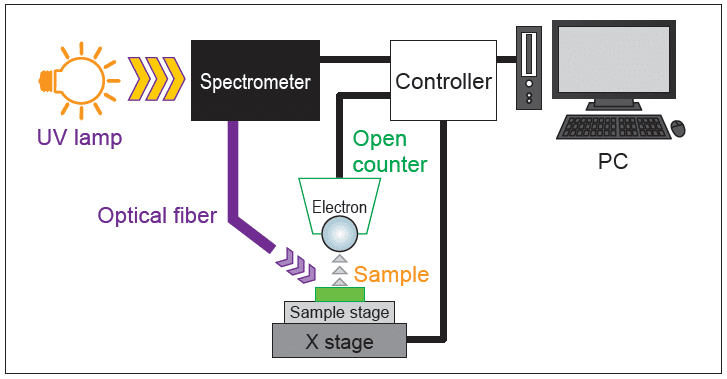
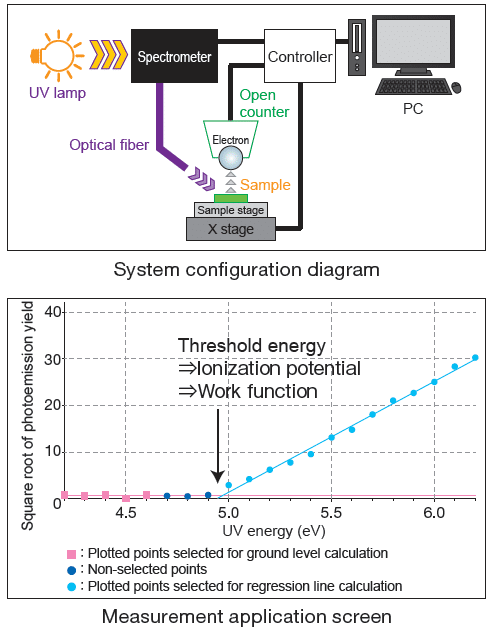 Ultraviolet light emitted from a UV lamp undergoes wavelength (energy) selection in a spectrometer before being focused on the surface of a sample placed on the sample stage.
An open counter (electron counting device) counts electrons discharged by the photoelectric effect (phenomenon in which electrons are discharged from material surface when the material absorbs light).
The wavelength λ of the ultraviolet light is converted into light energy E by the following equation:
E = hν = h・c/λ
(h: Planck constant, ν: frequency of light, c: speed of light, λ: wavelength)
Increasing UV energy makes it possible to obtain the photoemission threshold energy (work function*1 and ionization potential*2) as shown on the measurement application screen to the right.
*1 Photoemission threshold energy for metals
*2 Photoemission threshold energy for semiconductors