







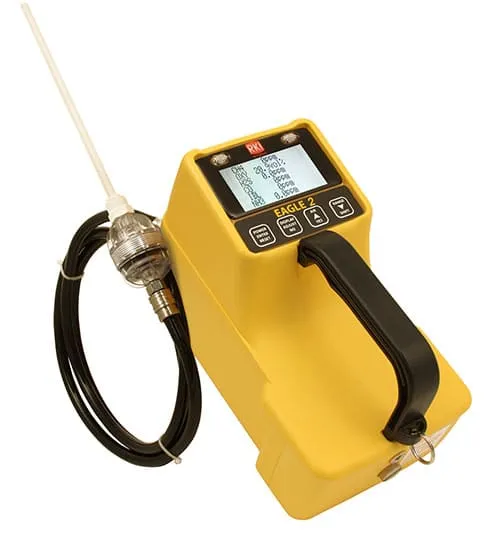
RKI Eagle 2
6 Gas Sample Draw Monitor
The EAGLE and EAGLE 2 have been two of the most popular monitors for decades, but due to the discontinuation of critical components, both instruments are no longer available. Replacement parts for the EAGLE and EAGLE 2, including sensors and filters, will continue to be available for many years.
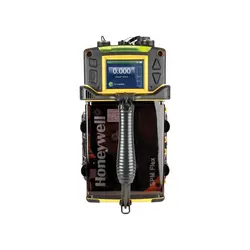
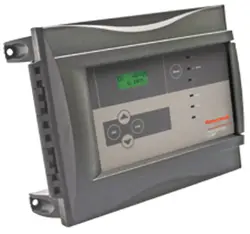
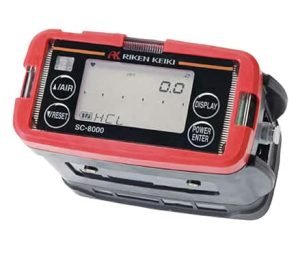
The GX-6000, GX-8000, and SC-8000 models are excellent alternatives to the EAGLE and EAGLE 2, especially for standard 4-gas and single gas toxic versions.

EAGLE 2 English Datatsheet [PDF]
EAGLE 2 Spanish Version [PDF]
EAGLE 2 Brochure (6 pages) [PDF]
EAGLE 2 Tanker Tester (4 pages)[PDF]
EAGLE 2 Inert Gas Tester Datasheet [PDF]
Quick Reference Guide [PDF]
EAGLE 2 Operator’s Manual [PDF]
EAGLE 2 Data Logger Management Program Operator’s Manual [PDF]
Data Logging Installation/Data Retrieval Instructions [PDF]
EAGLE 2 Maintenance Data Loader Operator’s Manual [PDF]
Suggested Alternative Product
| Features | 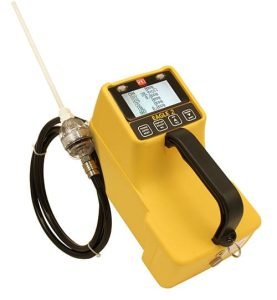 Eagle 2 Eagle 2 |
 GX-6000 GX-6000 |
 GX-8000 GX-8000 |
SC-8000 |
|
| Sensor Capacity | 6 | 6 | 5 | 1 toxic | |
| Sample Range | 125 feet | 50 feet | 100 feet | 100 feet | |
| Combustible Ranges | PPM Leak Check | • | • | ||
| % LEL | • | • | • | ||
| % Volume | • | • | • | ||
| Battery Life | 18 hrs NiMH 16 hrs Alkaline size C |
14 hrs Li-ion 8 hrs Alkaline size AA |
12 hrs Li-ion 6 hrs Alkaline size AA |
25 hrs Li-ion 18 hrs Alkaline size AA |
|
| Warranty | 2 years | 2 years | 1 year | 1 year | |
| Modes | Leak Check & Bar Hole | Leak Check & Bar Hole | |||
| Inert Mode | Combustibles | • | • | ||
| Oxygen | • | • | |||
| High Range H2S | 1,000 ppm (RX-8000) |
||||
| PID (Photoionization) | • | • | |||
| Toxic Gases | Ammonia (NH3) | 75.0 ppm | 400 ppm | 75.0 ppm | |
| Arsine (AsH3) | 1.5 ppm | 0.20 ppm | |||
| Bromine (Br2) | 1.00 ppm | ||||
| Carbon Dioxide (CO2) | 10K ppm 5, 60% vol.5 |
10K ppm 10% volume |
|||
| Carbon Monoxide (CO) | 500 ppm | 500 ppm | 500 ppm | 300 ppm | |
| Chlorine (Cl2) | 3.00 ppm | 10.0 ppm | 3.00 ppm | ||
| Chlorine Trifluoride (CLF3) | 1.00 ppm | ||||
| Diborane (B2H6) | 0.30 ppm | ||||
| Fluorine (F2) | 3.00 ppm | ||||
| Germane (GeH4) | 0.80 ppm | ||||
| Hydrogen Bromide (HBr) | 6.00 ppm | ||||
| Hydrogen Chloride (HCl) | 15.0 ppm | ||||
| Hydrogen Cyanide (HCN) | 15.0 ppm | 15.0 ppm | 15.0 ppm | ||
| Hydrogen Fluoride (HF) | 0.4-9.0 ppm | ||||
| Hydrogen Iodide (HI) | 5.00 ppm | ||||
| Hydrogen Peroxide (H2O2) | 3.00 ppm | ||||
| Hydrogen Selenide (H2Se) | 0.20 ppm | ||||
| Hydrogen Sulfide (H2S) | 100 ppm | 100 ppm | 100 ppm | 30.0 ppm | |
| Nitrogen Dioxide (NO2) | 20.0 ppm | 15.0 ppm | |||
| Nitric Oxide (NO) | 100 ppm | ||||
| Ozone (O3) | 1.00 ppm | ||||
| Phosphine (PH3) | 1.00 ppm | 20.0 ppm | 1.00 ppm | ||
| Phosphorus Trifluoride (PF3) | 10.0 ppm | ||||
| Silane (SiH4) | 15.0 ppm | ||||
| Sulfur Dioxide (SO2) | 6.00 ppm | 99.90 ppm | 6.00 ppm | ||
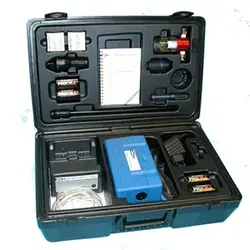
The EAGLE 2 is the solution for just about any portable gas monitoring situation. Equipped with features that are not available on competitive units, the EAGLE 2 is a powerful instrument that does more than just offer the standard confined space protection for LEL, O2, H2S and CO. The EAGLE 2 offers easy access to controls such as auto-calibration, alarm silence, demand zero, peak hold, and methane elimination. Each channel has two alarm levels plus TWA and STEL alarms for toxic channels. The two alarm levels are user adjustable and can be latching or self resetting.
The EAGLE 2 available features include a PID sensor for detecting high or low ppm levels (0-50 & 0-2,000) of VOC gases; % volume capability for CH4 and H2 using a TC (thermal conductivity) sensor; PPM or LEL hydrocarbon detection at the push of a button; infrared sensors for CO2 (ppm or % volume), methane or hydrocarbons in LEL and % volume ranges; methane elimination feature for environmental applications; and a variety of super toxic gases. The EAGLE 2 has a strong internal pump with a low flow auto pump shut off and alarm, which can draw samples from up to 125 feet. This allows for quick response and recovery from distant sampling locations. The EAGLE 2 will continuously operate for over 18 hours on alkaline batteries or 20 hours on NiMH. A variety of accessories are also available to help satisfy almost any application such as long sample hoses, special float probes for tank testing, and dilution fittings, just to name a few. Data-logging is a standard feature for all sensors on all versions.
The Eagle 2 is ideal for performing EPA Method 21 fugitive emission monitoring of VOC leaks from process equipment.. EPA Method 21- Determination of Volatile Organic Compound Leaks, is a test method used for the determination of leaks of VOCs from process equipment. The Eagle 2 meets the requirements for portable instruments used for this purpose as outlined in Sections 6 and 8 of Method 21. For more info about Method 21, see the RKI FAQ; Do the RKI Eagle and Eagle 2 Portable Gas Monitors Conform to EPA Method 21 Performance Criteria?
Specialty Sensors
The PID sensor is capable of detecting high or low ppm levels (0-50 & 0-2,000) of VOC gases. Other smart sensors include % volume capability for CH4 and H2 using a TC (thermal conductivity) sensor; ppm or LEL hydrocarbon detection at the push of a button; infrared sensors for CO2 (ppm or % volume), methane or hydrocarbons in LEL and % volume ranges; Optional LEL / ppm H2 specific sensor, methane elimination feature for environmental applications; and a variety of super toxic gases. EAGLE 2 is a powerful instrument that does more than just offer the standard confined space protection for LEL, O2, H2S and CO. Made In U.S.A
- PID (Photoionization Detector)
- Low or high range for VOC detection
- Humidity and contamination resistant
- Infrared (IR) CO2, % LEL CH4, % Vol. CH4, % LEL HC, % Vol. HC
- Thermal Conductivity (TC) % Vol. H2, % Vol. CH4
- Smart toxic, plug and play sensors NH3, AsH3, Cl2, HCN, PH3, & SO2
Specifications
| Enclosure | Weatherproof, chemical resistant, RFI / EMI coated high impact polycarbonate-PBT blend. Can operate in 2.0” of water without leakage. Ergonomically balanced with rugged top mounted handle. Water & dust resistant equivalent to IP64. |
| Dimensions | 9.5” L x 5.25” W x 5.875” H |
| Weight | 3.8 Lbs (standard 4 gas with batteries). |
| Detection Principle | Catalytic combustion, electrochemical cell, galvanic cell, infrared, Photoionization detector, and thermal conductivity. |
| Sampling Method | Powerful, long-life internal pump (over 6,000 hours) can draw samples over 125 feet. Flow rate approximately 2.0 SCFH. |
| Display | 3 display modes: display all gases, large font-autoscroll, or large font-manual scroll. Polyurethane protected overlay. Backlight, illuminates for alarms and by demand, with adjustable time. |
| Language | Readout can display in 5 languages (English, French, German, Italian, or Spanish). |
| Alarms | 2 Alarms per channel plus TWA and STEL alarms for toxics. The two alarms are fully adjustable for levels, latching or self reset, and silenceable. |
| Alarm Method | Buzzer 95 dB at 30 cm, four high intensity LED’s. |
| Controls | 4 External glove friendly push buttons for operation, demand zero, and autocalibration. Buttons also access LEL/ppm, alarm silence, peak hold, TWA/STEL values, battery status, conversion factors, and many other features. |
| Continuous Operation | At 70°F, 16 hours using alkaline batteries, or 18 hours using NiMH. |
| Power Source | 4 alkaline or NiMH, size C batteries (Charger has alkaline recognition to prevent battery damage if charging is attempted with alkalines). |
| Operating Temp. & Humidity | -20°C to 50°C (-4°F to 122°F), 0 to 95% RH, non-condensing. |
| Environmental | IP-64 |
| Response Time | 30 Seconds to 90% (for most gases) using standard 5 ft hose. |
| Safety Rating | Intrinsically Safe, Class I, Groups A, B, C, D. Approvals: CSA |
| Standard Accessories | Shoulder strap, alkaline batteries, hydrophobic probe, and 5 foot hose, internal hydrophobic filter. |
| Optional Accessories | • Dilution fitting (50/50) • NiMH batteries • Battery charger, 115 VAC, 220 VAC, or 12 VDC (charge time 4 hours) • Continuous operation adapter, 115 VAC or 12 VDC • Extension hoses • IRDA cable for datalogging download |
| Warranty | Two year material and workmanship, one year for PID sensor. |
Parts
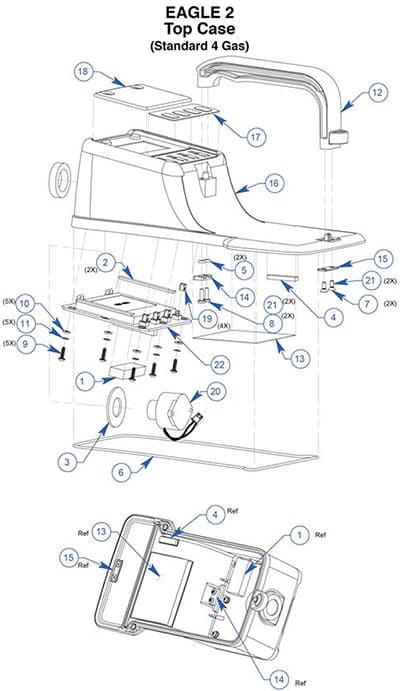
| Part Number | Part Number | ||
| 1 | 07-0017RK | 12 | 13-0002RK |
| 2 | 07-0132RK | 13 | 14-0011RK |
| 3 | 07-0133RK | 14 | 14-0050RK |
| 4 | 07-0134RK | 15 | 14-0051RK |
| 5 | 07-7005RK | 16 | 21-0630RK |
| 6 | 07-7070RK-50 | 17 | 29-0338RK |
| 7 | 10-0117RK | 18 | 29-0339RK |
| 8 | 10-0119RK-01 | 19 | 43-0417RK-01 |
| 9 | 10-0121RK | 20 | 52-1019RK-01 |
| 10 | 11-0220RK | 21 | 08-0202RK |
| 11 | 11-0221RK | 22 | 57-0103RK |
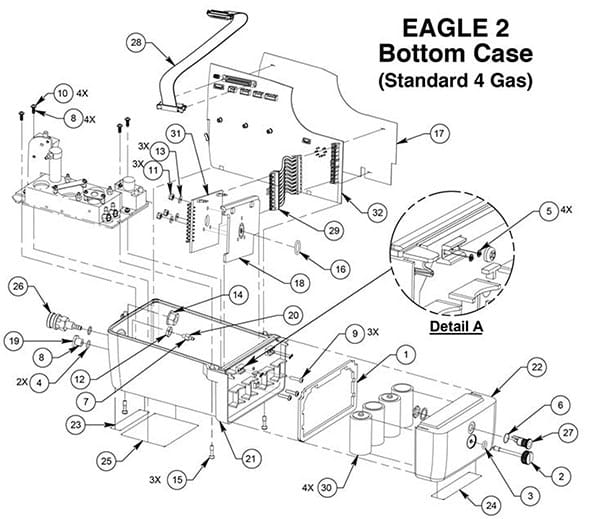
| 1 | 07-0131RK | 9 | 10-0129RK-01 | 17 | 14-0010RK | 25 | 29-0337RK |
| 2 | 13-1081RK | 10 | 10-0194RK-05 | 18 | 14-0142RK | 26 | 30-0522RK |
| 3 | 07-7010RK | 11 | 110025RK | 19 | 17-0480RK | 27 | 45-2311RK |
| 4 | 07-7300RK | 12 | 11-0111RK | 20 | 17-0633RK | 28 | 47-5057RK |
| 5 | 07-7301RK | 13 | 11-0222RK | 21 | 21-0631RK-03 | 29 | 47-5059RK |
| 6 | 07-7302RK | 14 | 11-4021RK | 22 | 21-0642RK | 30 | 49-1130RK |
| 7 | 08-0191RK | 15 | 13-1061RK | 23 | 29-0335RK | 31 | 57-0100RK |
| 8 | 08-0202RK | 16 | 07-7014RK | 24 | 29-0336RK | 32 | 57-0102RK-01 |
Gases & Detectable Ranges
The EAGLE 2 can be configured with up to 6 gas sensors from the list below.
| Gas | Measuring Range | Accuracy * Which ever is greater |
| Gases & Detectable Ranges | ||
| Standard Confined Space Gases | ||
| Hydrocarbons (CH4, std) | 0 – 100% LEL | ± 5% of reading or ± 2% LEL (*) |
| 0 – 5% Vol. (CH4) | ||
| 0 – 50,000 ppm | ± 50 ppm or ± 5% of reading (*) | |
| Oxygen (O2) | 0 – 40% Vol. | ± 0.5% O2 |
| Carbon Monoxide (CO) | 0 – 500 ppm | ± 5% of reading or ± 5 ppm CO (*) |
| Hydrogen Sulfide (H2S) | 0 – 100 ppm | ± 5% of reading or ± 2 ppm H2S (*) |
| Toxics | ||
| Ammonia (NH3) | 0 – 75 ppm | ± 10% of reading or ± 5% of full scale (*) |
| Arsine (AsH3) | 0 – 1.5 ppm | |
| Chlorine (Cl2) | 0 – 3 ppm | |
| Hydrogen Cyanide (HCN) | 0 – 15 ppm | |
| Phosphine (PH3) | 0 – 1 ppm | |
| Sulfur Dioxide (SO2) | 0 – 6 ppm | |
| IR Sensors | ||
| Carbon Dioxide (CO2) | 0 – 10,000 ppm 0 – 5% Vol. 0 – 60% Vol. | ± 5% of reading or ± 2% of full scale (*) |
| Methane (CH4) | 0 – 100% LEL/ 0 – 100% Vol. | |
| Hydrocarbons | 0 – 100% LEL/ 0 – 30% Vol. | |
| PID Sensors | ||
| VOC | 0 – 2,000 ppm 0 – 50 ppm | — |
| TC Sensors | ||
| Methane (CH4) | 0 – 100% Vol. | ± 5% of reading or ± 2% of full scale (*) |
| Hydrogen (H2) | 0 – 10% Vol. 0 – 100% Vol. | |
| Hydrogen Specific | ||
| Hydrogen (H2) | 0-100% LEL 0-40,000 ppm | ± 5% of reading or ± 2% of full scale (*) |
EAGLE 2 PID Response Factors for VOCs
Photoionization detectors are calibrated using isobutylene, but PID is a broadband VOC detection technique, with a sensitivity that differs for each VOC. If you know what VOC you are detecting, then the table below will allow you to calculate the concentration for your specific VOC. Remember, these are approximate values, so for best accuracy you should calibrate with the relevant VOC. Multiply the indicated concentration by the appropriate Relative Response value to provide an estimate of actual VOC concentration. Download PDF of Eagle 2 PID Response Factors for VOCs
Special Features
- Low flow alarm shuts pump off to avoid damage to instrument.
- Hydrophobic filter disc in probe.
- Internal hydrophobic filter.
- Single gas calibration capability.
- Methane elimination feature for environmental applications.
- Security Password protected.
- Meets EPA Method 21 protocol for fugitive emissions testing (most applications).
- Plug and play toxic sensors.
- Datalogging available for all configurations.
- Transformer gas testing version available.
Specifications subject to change without notice.
PID Sensor Response Factors for VOCs
Photoionization detectors are calibrated using isobutylene, but PID is a broadband VOC detection technique, with a sensitivity that differs for each VOC. If you know what VOC you are detecting, then the table below will allow you to calculate the concentration for your specific VOC. Remember, these are approximate values, so for best accuracy you should calibrate with the relevant VOC. Multiply the indicated concentration by the appropriate Relative Response value to provide an estimate of actual VOC concentration. Download a PDF of PID Response Chart.